
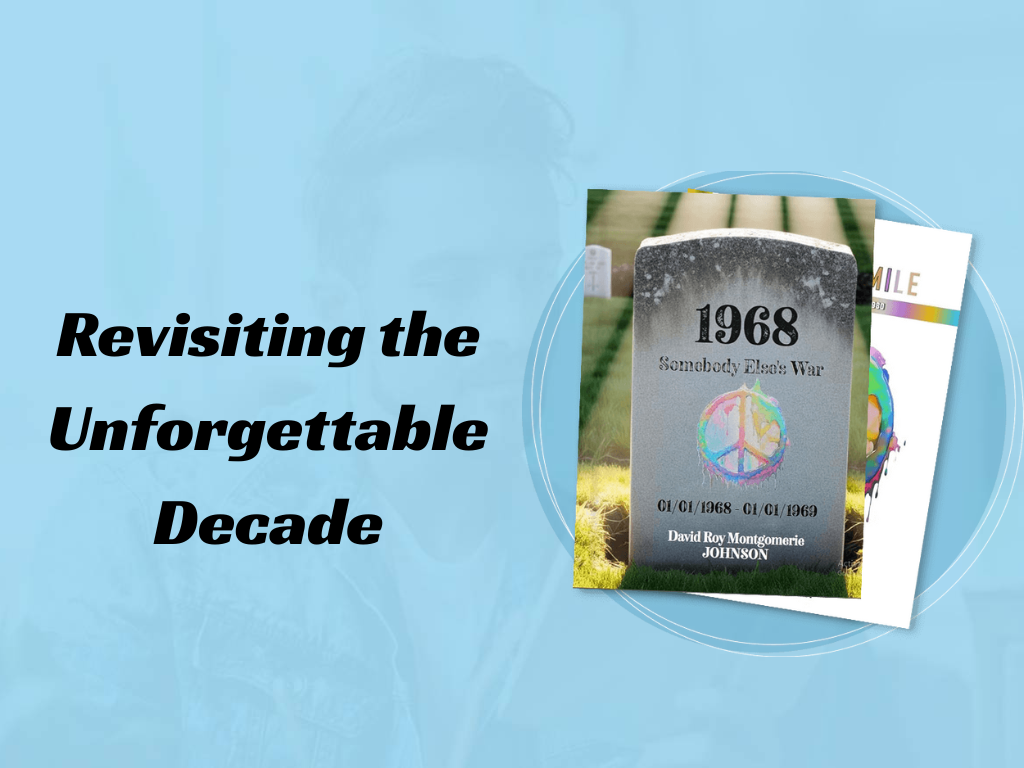
The time of the 1960s was not a common era in modern history; this was an age where rebellion, revolution, and a big change occurred. It was a time when songs that touched the hearts, movements that shook the governments, and moments that made the generations. But in the midst of the confusion and the bravery, there was laughter and the attempt of human beings to make sense of everything happening around them. 1968 – Somebody Else’s War by David Roy Montgomerie Johnson takes the readers back to an era, not with the speeches, but with the living people who were in the shadow of the decade.
The novel takes place in the year 1968 and takes the readers into the setting of a small Canadian town named Newport on the Lake, which was far away from where the war was happening, but close enough to get a taste of the war. The author, in his book, has focused on conveying the message to his readers through simple words and narration. On one hand, the rest of the world struggles with assassinations, riots, and revolution; on the other hand, his characters struggle with their own wars of conscience, love, and belonging.
The late sixties were characterized by contradictions. It was the period of peace signs and anti-war demonstrations, of love-ins and disappointments. Johnson has no reservations about that contrast; he welcomes it. 1968 – Somebody Else’s War, with its wistful and touching story, demonstrates events that took place during that time. His book is full of dreamers and skeptics, lovers and cynics, all trying to figure out what was going on around them, as the world passed faster than anyone could follow.
The whole decade is a microcosm of life in Newport-on-the-Lake. The townspeople are vivid, imperfect, and memorable. The pompous, but strangely appealing, Lord Mayor Wentworth Clarkson-Hayes IV opens with the type of self-importance that resembles the political ones of the decade. Police Captain Sammy Enfield is an exhausted veteran of two wars who is having a hard time maintaining order in his neighborhood and within himself. Then there’s April May June, a young woman wiser than her years, who symbolizes the agitator youth who dared to ask a question. All of the characters are a reflection of the 1960s, its power and defiance, and its love, humor, and hopelessness.
The key to this story is Johnson’s humor. He composes it with a satirical acuity that causes the readers to laugh and keep in mind the truth that is concealed inside the absurdity. Laughter was the most reasonable reaction in the world that appeared to be on the edge of hope and hysteria. With instances of comedy and confusion, 1968 – Somebody Else’s War makes readers remember that comedy does not eliminate pain, but will help us to live.
This novel not only takes the readers back to the 1960s but it also provides us a way to look at what made that decade memorable. The author’s characters might not change the horrific events taking place in the world around them, but they experience the change in themselves. They fall, make fun, and learn, which depicts the strength of a generation that never lost hope.
But he strikes a balance between this realism and compassion and humor and provides readers with thought and reprieve. In the modern, busy, polarized world, such a balance is particularly invigorating.
Reading 1968 – Somebody Else’s War is like traveling in a time capsule, not only to see it but also to touch it. The odor of the cigarette smoke, the buzz of the radio news, the strain of a political dinner dialogue, Johnson recreates it all so well that the readers can certainly feel the protest chants and the rock and roll in the background. It is not just his storytelling that makes the past come alive, but it also makes it personal.