
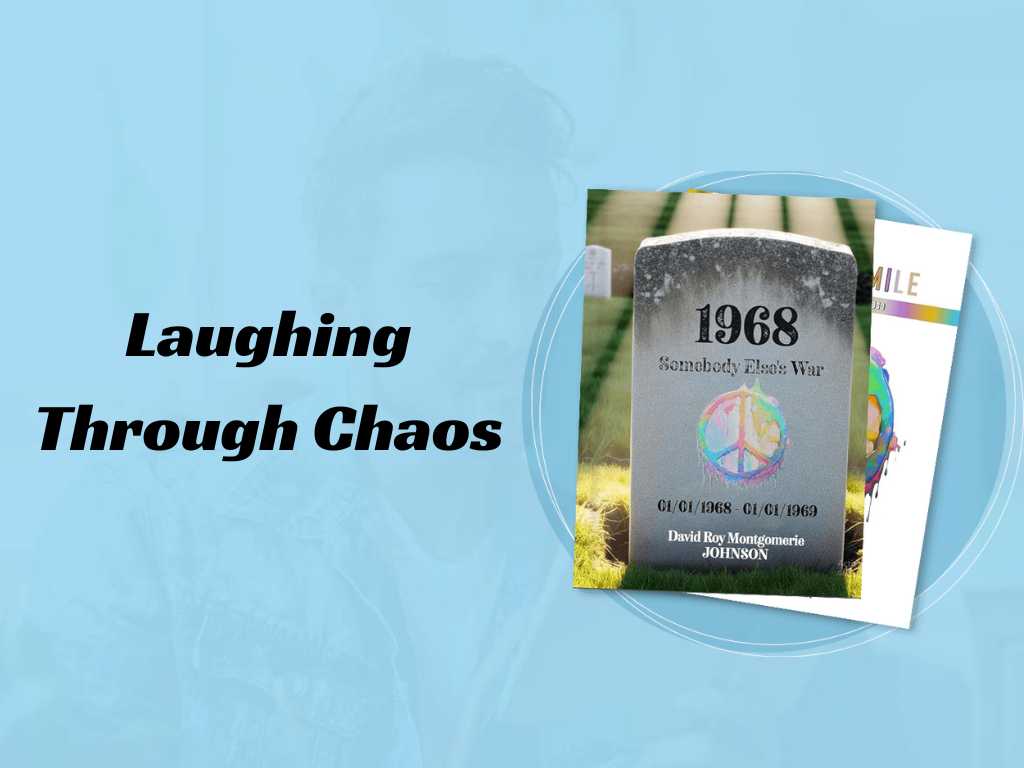
The end of the 1960s was not a usual time. With political killings, demonstrations, and the insanity of war, life appeared as a series of continuous breaking news. But in the mass, laughter had not died. It was itself a kind of rebellion, a means of maintaining humanity in an age that seemed to lose the art. Here, someone can find the same spirit in 1968 – Somebody Else’s War, by David Roy Montgomerie Johnson, who is able to include the sense of humor and the heartbreak, and how to laugh, to be the only reasonable reaction to the insane world.
The book 1968 – Somebody Else’s War takes the readers to the small Canadian town of Newport-on-the-Lake, where the disorder that is happening in the rest of the world trickles into the town’s people’s daily lives. The town consists of many strange people, including a police captain with his war scars, a mayor who cares only about his reputation and ego, and townspeople who have their own strange habits that make them unbelievable and, at the same time, charming. They are not superheroes or some of the great characters in history; they are just ordinary people who are trying to find their way in unusual circumstances.
Captain Sammy Enfield among them is not laughing at tragedy, but instead, he is laughing at the tragedy like nightmares of battle, loneliness, in between all he struggles to remake a shattered marriage that keeps Sammy in a state of conflict with his absurd life, and the only way he knows how to keep living is with a smile on his face and determination not to give up. Even his comic scenes are not slapstick jokes but silent successes, the type that makes readers remember that laughter is a protective and therapeutic power.
The rest of the inhabitants in the town bring in additional humor and warmth. Lord Mayor Wentworth Clarkson Hayes IV, e.g., is the ideal caricature of a town official, pompous, proud, but strangely likable. His preoccupation with appearance and structure fails miserably before the daily malpractices, such as cars hitting clock towers or townspeople causing mayhem by gossiping. Johnson uses him to make fun of power itself, not viciously, just to make fun of it, to reveal how vulnerable the human ego is. Mayor Anarchy is our anarchy, and his efforts toward its management are our efforts.
The reason why 1968 – Somebody Else’s War is such an interesting read is that the humor of the book is more human. The comedy that it evokes is not provided by slapstick but by identification. Readers can identify themselves with the confusion in that town and its contradictions, its efforts to remain decent in a world that is not always decent. All the dialogues, all the accidents, and all those little achievements of life are like a wink of history; it serves as a reminder that even though life gets ridiculous, we have all been in this situation at some point.
There is a gentle insight into the times under the wit and warmth. The world appeared to be rotating off its tracks, as witnessed in the battlefields of Vietnam, as well as in the American streets, where there were demonstrations. Johnson takes these grandiose moments down to a close. They do not seem far away, but it is like the echo that defines the life of people thousands of miles away. It is this silence of tension that exists between the individual and the political, the serious and the ridiculous, that makes the novel so powerful.
Johnson does not lose his sense of humor, however, in it all. His writing is stinging and flirtatious, with acute dialogue and scenes that make readers smile, challenging them to consider. He is reminding us that the darkest moments in the history of mankind are usually concealing the most ironic sources of brightness.
It is that world that brings conflict and corruption, that also brings resiliency and laughter. The comicality and the tragedy that happen to exist together make the heartbeat of the book.
1968 – Somebody Else’s War will be hard to resist for the reader who wants to find a story that is full of nostalgia, laughter, and meaning. It is not only a trip back in memory but also an opportunity to look at the past differently. The spirit of an era has been celebrated in the novel but not idealized, showing all the madness but not ignoring its humor. It demonstrates that laughter is not the lack of pain but evidence that we have gone through it through its ensemble of imperfect, humorous, and memorable characters.