
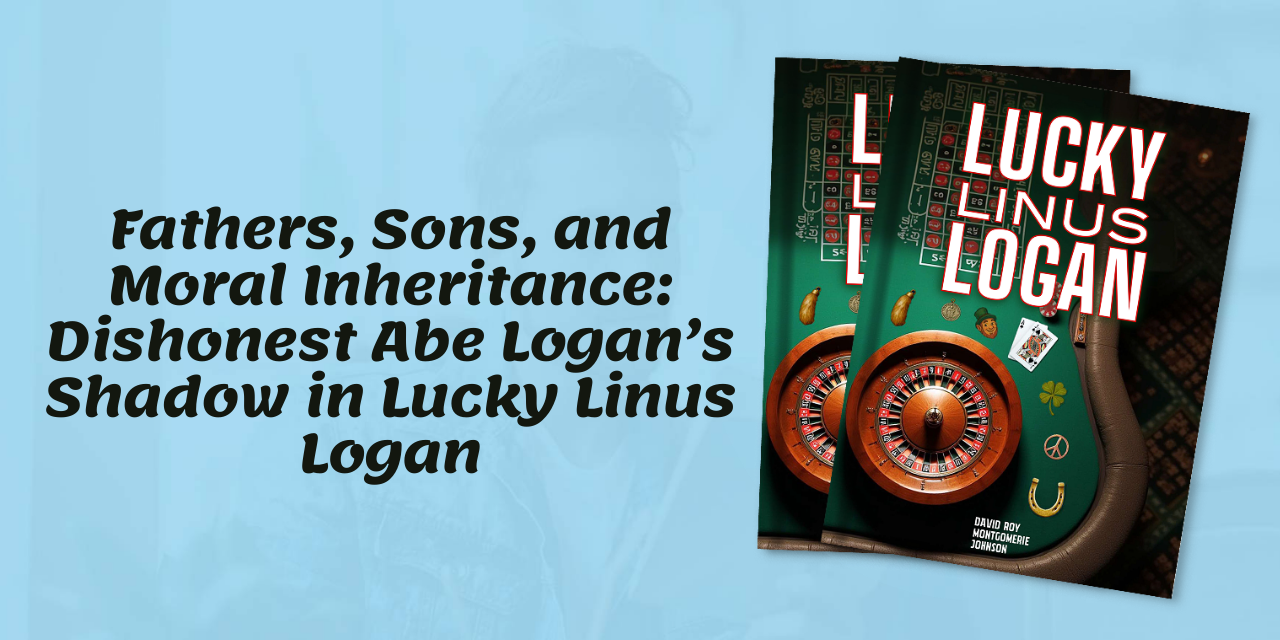
In Lucky Linus Logan by David Roy Montgomerie Johnson, crime is not merely an external threat or plot device; it is a legacy passed down through family lines. At the center of this inheritance stands Abraham “Dishonest Abe” Logan, Linus’s father, a charismatic, morally flexible outlaw whose presence looms over the novel even when he is not on the page. Dishonest Abe is neither a villain nor a hero, but something more unsettling, a man whose charm and survival instincts shape his son’s moral landscape in ways both subtle and profound.
Dishonest Abe Logan: The Charismatic Outlaw
Dishonest Abe Logan is introduced as a figure who commands attention. He is clever, persuasive, and perpetually one-step ahead of consequences. Unlike the violent criminals of popular crime fiction, Dishonest Abe operates through wit, deception, and opportunism. He knows how to read people, exploit weaknesses, and navigate risk without appearing reckless.
This charisma makes Dishonest Abe dangerous, not because he is overtly cruel, but because he makes wrongdoing seem manageable, even reasonable. His criminality is practical rather than ideological. He does not seek chaos or domination; he seeks survival. In this way, Dishonest Abe embodies a form of outlaw masculinity rooted in adaptability rather than aggression.
The Father–Son Dynamic between Dishonest Abe and Linus
The relationship between Dishonest Abe and Linus is defined by proximity rather than intimacy. Dishonest Abe is present, but emotionally distant. He does not lecture his son on right and wrong, nor does he openly groom him for criminal life. Instead, he lives his values openly, allowing Linus to absorb them through observation.
Linus grows up watching his father bend rules, charm his way out of trouble, and treat legality as a flexible concept. Yet there is no romantic bonding over crime. Dishonest Abe does not invite admiration; he invites understanding. This quiet, observational relationship makes the moral inheritance more complex. Linus is not rebelling against his father, nor is he imitating him outright; he is negotiating with the example placed before him.
Criminal Pragmatism versus Personal Ethics
Dishonest Abe’s worldview is built on pragmatism. Rules exist to be navigated, not obeyed. Consequences matter more than intentions. For Dishonest Abe, morality is secondary to survival. This philosophy stands in tension with Linus’s developing ethical instincts.
Linus inherits his father’s caution, adaptability, and ability to read situations, but not his moral flexibility. Where Dishonest Abe sees opportunity, Linus sees risk. Where Dishonest Abe prioritizes self-preservation, Linus considers collateral damage. This contrast forms one of the novel’s central moral conflicts: how much of a parent’s survival strategy can be inherited without inheriting their compromises?
Lessons Learned Indirectly Through Observation
One of the novel’s most effective techniques is its depiction of learning through observation rather than instruction. Dishonest Abe never delivers speeches about crime or morality. Instead, Linus learns by watching outcomes. He sees when Dishonest Abe’s charm works and when it fails. He observes the long-term costs of short-term solutions.
These indirect lessons shape Linus’s cautious approach to wrongdoing. He understands the mechanics of crime, but he also understands its limits. This dual awareness allows him to move through criminal spaces without becoming consumed by them. Knowledge, in this case, becomes a defensive tool rather than an invitation.
Dishonest Abe’s Influence and Linus’s Moral Complications
Dishonest Abe’s shadow complicates every major decision Linus makes. When confronted with criminal choices, Linus must weigh not only the immediate stakes but also the example he has inherited. He knows how easy it is to justify small transgressions, how quickly pragmatism can slide into moral erosion.
This internal conflict prevents Linus from adopting clear-cut heroism. He is neither naive nor righteous. Instead, he operates with an awareness that doing the “right” thing often comes at a cost. Dishonest Abe’s influence ensures that Linus never mistakes morality for simplicity.
Generational Cycles of Crime and Survival
Lucky Linus Logan suggests that crime is often cyclical, passed down through economic hardship, social limitation, and learned behavior. Dishonest Abe represents a generation that survived through adaptability and moral compromise. Linus represents the next generation, one with greater awareness but fewer illusions.
The novel does not condemn Dishonest Abe for his choices, nor does it excuse them. Instead, it frames crime as a survival response shaped by time, place, and circumstance. Linus’s challenge is not to erase his father’s influence, but to reinterpret it.
Divergence without Denial
The most meaningful moments in the novel occur when Linus diverges from his father’s path. He refuses to exploit the vulnerable. He draws firm ethical lines around children and abuse. He chooses restraint over advantage, even when pragmatism would suggest otherwise.
These decisions do not reject Dishonest Abe outright. Instead, they refine the inheritance. Linus keeps his father’s situational awareness and skepticism, but tempers them with accountability. This evolution represents growth rather than rebellion.
Choosing Integrity While Honoring Roots
In the end, Lucky Linus Logan offers a nuanced portrait of moral inheritance. Dishonest Abe Logan’s shadow is long, but it is not escapable. Linus does not become virtuous by denying his roots; he becomes ethical by understanding them.
David Roy Montgomerie Johnson suggests that integrity is not the absence of flawed influence, but the conscious shaping of it. Linus Logan’s quiet heroism lies in his ability to carry his father’s lessons without repeating his mistakes, a choice that defines both the man he becomes and the story he inhabits.


