
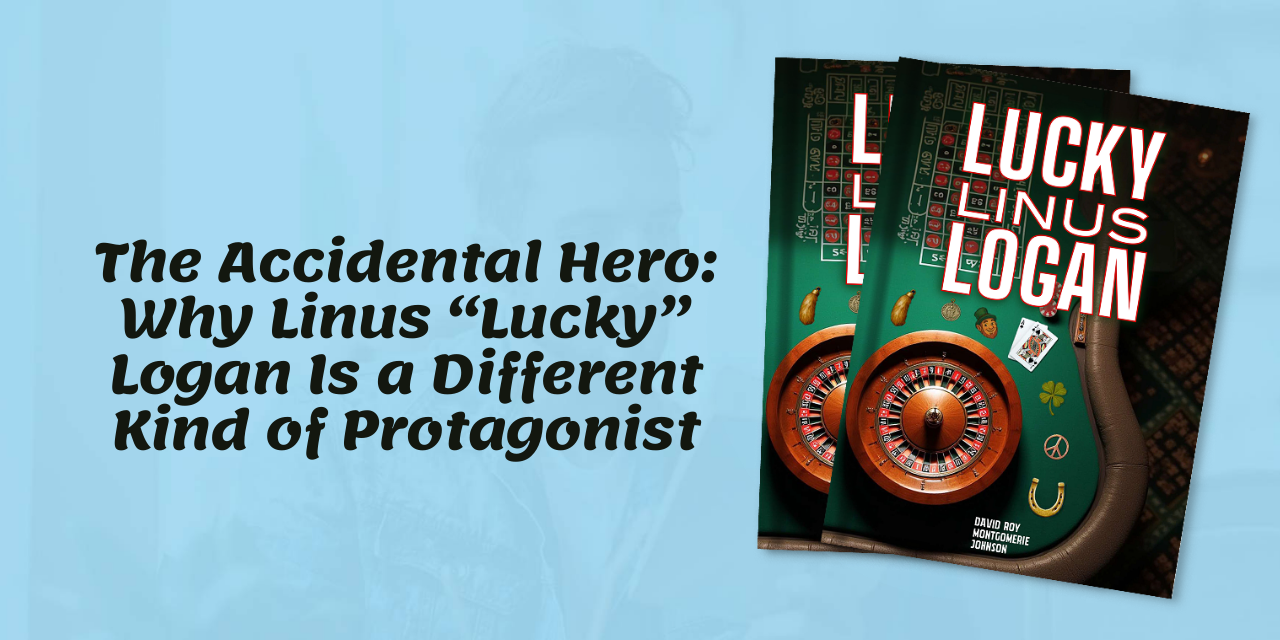
In contemporary fiction, heroes often arrive pre-packaged with exceptional talents, moral certainty, and an almost supernatural ability to rise above adversity. These characters are frequently marked by destiny, prophecy, or a defining skill that sets them apart from ordinary people.
Linus “Lucky” Logan, the protagonist of Lucky Linus Logan by David Roy Montgomerie Johnson, stands in sharp contrast to this tradition. He is not polished, not ambitious, and not searching for greatness. Yet through a series of grimly comic misadventures, personal losses, and moral crossroads, Lucky becomes something far more compelling: an accidental hero shaped by survival, loyalty, and an unshakable, if understated, sense of fairness.
A Blue-Collar Life without Destiny
Lucky Logan is introduced as a working-class man in early 1980s industrial North America, employed at a General Motors plant. His life is structured by shift work, union rules, factory banter, and beer shared in coffee mugs rather than pint glasses. This grounded beginning is crucial to the novel’s success. Lucky does not come from privilege or prophecy; he comes from routine. His world is blue-collar, skeptical, and familiar, and it reflects a social class often overlooked in heroic narratives.
This setting anchors the story in realism. Because Lucky’s life is ordinary, his eventual entanglement in criminal intrigue and moral crisis feels organic rather than contrived. He does not step into danger seeking adventure; danger intrudes upon a life defined by habit and survival. In this way, Johnson reframes heroism as something that emerges not from aspiration, but from circumstance.
The Irony behind the Name “Lucky”
The nickname “Lucky” is deeply ironic. Throughout his life, Logan has endured extraordinary trauma: the loss of his mother and sister in a car accident, brutal experiences during the Vietnam War, and constant proximity to criminal behavior through his father, Abraham Logan, a charming, manipulative, and deeply dishonest man. Lucky survives these ordeals not because he is invincible or heroic in the traditional sense, but because chance repeatedly spares him.
Each survival reinforces a reputation he never asked for and never fully believes in. His “luck” becomes less a blessing than a burden, creating expectations he never embraces nor openly rejects. The name follows him like a joke with a cruel edge, highlighting the gap between how others see him and how he sees himself. This tension adds emotional depth and reinforces the novel’s skepticism toward simplistic labels.
A Personal Moral Code in a Corrupt World
What truly distinguishes Lucky as a protagonist is his moral pragmatism. He is not lawless, but neither is he obedient. He refuses to be a “grass”, yet he draws clear ethical lines protecting children, opposing domestic violence, and resisting exploitation whenever possible. His morality is situational rather than ideological, shaped by lived experience rather than abstract principles.
In a world populated by bikers, bootleggers, crooked cops, and petty criminals, Lucky operates according to a personal code rather than institutional authority. This code does not make him pure or self-righteous, but it does make him reliable. Others may not always like him, but they trust him, and in Lucky’s world, trust is more valuable than respect.
The Body in the Field: A Catalyst for Action
The novel’s central turning point of the discovery is a dead body near his father’s marijuana patch forces Lucky into reluctant action. What begins as a darkly comic logistical problem quickly escalates into something far more dangerous and morally complex. The body becomes symbolic of Lucky’s lifelong position: caught between right and wrong, legality and loyalty, inaction and responsibility.
Lucky does not rush forward with bravado. He hesitates, calculates, and resists involvement. Yet once engaged, he cannot simply walk away. His decision to act is not heroic in appearance, but it is ethically decisive. This moment crystallizes the novel’s central claim: heroism often begins with reluctance rather than confidence.
Crossing Worlds to Find the Truth
As the story unfolds, Lucky is drawn into a missing-person case involving Candy Anguish, a fourteen-year-old girl whose disappearance exposes the darker underbelly of the region. Here, Lucky’s accidental heroism fully emerges. Unlike law enforcement, who become constrained by tunnel vision, bureaucracy, and political pressure, Lucky listens. He notices details others dismiss and asks questions that fall outside official narratives.
He moves between the world’s factory floors, biker bars, church offices, and criminal hangouts because he belongs nowhere and everywhere at once. This social invisibility allows him access where authority fails. Lucky’s strength lies not in force, but in attention and empathy.
Trust, Resistance, and Human Imperfection
Lucky’s greatest weapon is trust. Bikers trust him because he does not judge them. Criminals trust him because he keeps his mouth shut. Police tolerate him because he understands limits. His heroism is quiet, relational, and built on credibility rather than violence.
Equally important is his resistance to power. Lucky does not seek promotions, leadership, or recognition. When authority figures or organized crime attempt to use him, he pushes back subtly, often through humor, deflection, or feigned ignorance. Staying underestimated is his survival strategy.
Heroism without Ambition
Ultimately, Linus “Lucky” Logan represents a rare kind of protagonist: one whose heroism is unintentional, situational, and deeply human. He does not chase justice, but he responds to it when it confronts him. In Lucky Linus Logan, David Roy Montgomerie Johnson reminds readers that the most believable heroes are often the ones who never wanted the job, only the courage to do it when it mattered the most.


