
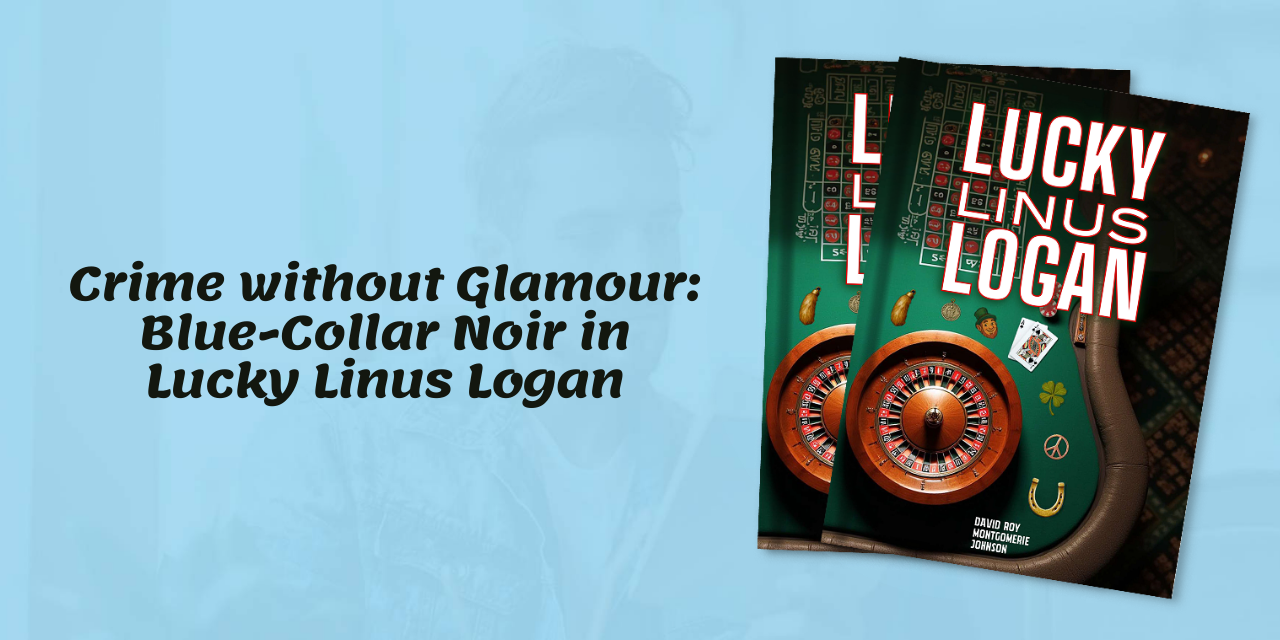
Crime fiction has long been fascinated with style, sharp suits, smoky bars, fast cars, and criminals who operate with precision and flair. In contrast, Lucky Linus Logan by David Roy Montgomerie Johnson strips crime of its romance and presents it as something far more familiar, awkward, and unglamorous. Rooted in working-class life and rural-industrial settings, the novel exemplifies blue-collar noir, a subgenre where crime is not exotic or elegant, but mundane, messy, and deeply human.
Defining Blue-Collar Noir and Rural Crime Fiction
Blue-collar noir focuses on crime, as it exists among ordinary people, factory workers, minor hustlers, rural families, and aging criminals clinging to relevance. Unlike urban noir, which often centers on detectives navigating corrupt cities, blue-collar noir unfolds in places defined by labor, routine, and economic limitation. Violence and corruption exist, but they are woven into everyday survival rather than grand criminal empires.
Lucky Linus Logan fits squarely within this tradition. Set in early 1980s industrial North America, the novel blends rural crime fiction with noir sensibilities. Its criminals are not masterminds; they are neighbors, coworkers, and relatives. Crime emerges not from ambition, but from necessity, boredom, resentment, and opportunity.
The GM Plant as a Backdrop for Everyday Survival
The General Motors plant where Linus “Lucky” Logan works is more than a setting; it is a thematic anchor. The plant represents stability, routine, and the fragile promise of economic survival. Shift work, union rules, and factory banter define Lucky’s life far more than criminal intrigue ever does.
By grounding the narrative in industrial labor, Johnson emphasizes that crime is not Lucky’s world, and it intrudes upon it. The factory provides contrast: a place of predictable hardship against the unpredictable dangers of criminal involvement. This backdrop reinforces the novel’s realism, reminding readers that most people involved in crime would rather be clocking in, being paid, and going home alive.
Organized Crime as Mundane, Sloppy, and Human
One of the novel’s most striking subversions is its portrayal of organized crime. There are no sleek syndicates or impeccably planned operations. Instead, criminal activity is disorganized, impulsive, and often incompetent. Deals go wrong. People panic. Mistakes compound.
These criminals are recognizable as flawed individuals, greedy, frightened, sentimental, or simply careless. Johnson presents organized crime not as an elite system, but as an extension of human weakness. This demystification strips crime of its allure and reframes it as a risky, exhausting way to barely stay ahead of consequences.
Petty Hustles, Stolen Goods, and Quiet Corruption
Much of the criminal activity in Lucky Linus Logan exists at a small scale: stolen items, drug patches, favors owed, and information quietly traded. This emphasis on petty hustles reinforces the novel’s blue-collar sensibility. Crime here is not about domination or wealth; it is about scraping by.
Quiet corruption seeps into daily life. People look the other way. Rules bend. Authority figures compromise. None of this is portrayed as shocking; it is presented as normalized behavior in an economically strained environment. Johnson suggests that corruption flourishes not through dramatic acts of evil, but through repeated, unremarkable choices to ignore wrongdoing.
Violence Implied Rather Than Sensationalized
Unlike many crime novels, Lucky Linus Logan rarely indulges in graphic violence. Threats often linger off-page. Consequences are implied through tension, silence, and aftermath rather than explicit brutality. This restraint makes the danger feel more real.
Violence is treated as something people fear, not something they admire. When it occurs, it disrupts lives rather than advancing excitement. This approach aligns with noir’s emotional weight while rejecting its occasional tendency toward spectacle. The result is a narrative where unease matters more than action.
Humor as a Coping Mechanism in Grim Circumstances
Dark humor runs throughout the novel, functioning as both tonal balance and survival strategy. Characters joke not because life is funny, but because laughter provides distance from despair. Lucky himself often responds to danger with understatement, sarcasm, or quiet irony.
This humor never trivializes suffering. Instead, it reflects how working-class communities cope with instability by laughing at the absurdity of situations, they cannot fully control. The humor deepens realism, making the grim moments feel earned rather than overwrought.
Subverting Classic Noir Tropes
Classic noir often centers on a sharp-tongued detective navigating femme fatales, corruption, and moral ambiguity. Lucky Linus Logan borrows the ambiguity but rejects the glamour. Lucky is not a detective, not especially clever, and not interested in uncovering the truth for its own sake.
There is no seductive city, no stylish antihero. Instead, there is fatigue, reluctance, and moral improvisation. Lucky’s choices are reactive, not strategic. By replacing noir’s polish with weariness and restraint, Johnson modernizes the genre while honoring its ethical complexity.
Realism over Romance in Crime Storytelling
Ultimately, Lucky Linus Logan argues for realism over romance in crime fiction. Crime is not exciting, but it is inconvenient, frightening, and often stupid. Heroism is not triumphant, but it is accidental and exhausting.
By presenting crime through a blue-collar lens, David Roy Montgomerie Johnson reminds readers that the most compelling stories are not about criminals who live large, but about ordinary people trying to survive when crime crosses their path. In stripping away glamour, the novel reveals something far more powerful: truth.


